From the
Taoist Culture and Information Center...
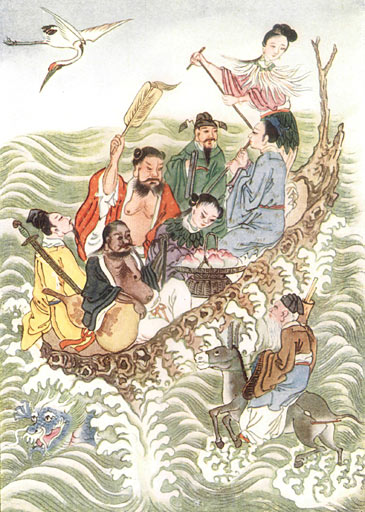
The Eight Immortals referred to eight Daoist Immortals who were popularly worshiped by Daoist sects as well as ordinary people. They were Zhong Liquan, Zhang Guolao, Lu Dongbin, Li Tieguai, He Xiangu, Nan Caihe, Han Xiangzi and Chao Guojiu. The Eight Immortals of Daoism had nothing to do with other similar callings such as the Han dynasty's Eight Gentlemen of Huainan, the Tang dynasty's Eight Drunken Immortals and the Eight Immortals of Ancient Sichuan. The Daoist version of the Eight Immortals came into being during the Song and Yuan dynasties. Yuan dynasty dramas such as The Yueyang Pavilion by Ma Zhiyan, The Bamboo Raft by Fan Zi'an and the Willow Tree in the South of the City by Gu Zijing depicted the Eight Immortals, whose characteristics were very close to what we see today. After the middle period of the Ming dynasty when Wu Yuantai published his novel The Journey to the East, Where the Eight Immortals Came From, the depiction of the Eight Immortals was completed...
For most Chinese people, the Eight Immortals represented eight factors in their daily life: men and women, old and young, the rich and the poor, the noble and the lowly. In addition, the things the Eight Immortals held in their hands -- castanets, fan, stick, sword, calabash, duster and flower basket -- were popularly found among and used by ordinary people in later period. It shows that the Eight Immortals were very close to the daily life of Daoist believers as well as to ordinary Chinese people. That explains why stories about the Eight Immortals could be so popular and influential in Chinese society. Special halls were dedicated to the Eight Immortals in most Daoist temples. In Xi'an city, there is an Eight Immortals Temple, which was called the Eight Immortals Studio in ancient times, where the Eight Immortals were worshiped in the main hall. During spring festival as well as the first and fifteenth days of the lunar month, Daoist believers and ordinary people used to come to the Eight Immortals Hall, showing their respect and praying for good health and good luck.
Labels: daoism


